The very first memory that I have of coming across a Joseph Wright (1734-1797) painting was during a visit to the Hermitage in St Petersburg, Russia some years ago. This painting was titled Iron Forge Viewed From Without, and I was immediately struck by the marked chiaroscuro technique clearly demonstrated here.
This term, derived from the Italian for “light-dark” describes a painting technique (although it can also be used in photography) which uses strong light-dark contrasts to give a 3D effect. This can be quite dramatic, as indeed it was in the case of The Hermitage painting. This technique was developed during the Renaissance, especially by artists such as da Vinci, Caravaggio and Rembrandt.

I already knew that Joseph Wright had a Derby connection, but I hadn’t thought too much about this, as my interest in Art tended to be focused on perhaps more well-known artists. Incidentally, this was the first English painting to enter the Hermitage when it was acquired by Catherine the Great in 1774. Wright painted five pictures of an iron forge between 1771 and 1773 – this was the last.

My treks around the world continued, and my next memory of a Joseph Wright painting was during a visit to the National Gallery of Victoria in Melbourne, Australia. Here, I came across his Self-portrait, and also his Anna Romana Wright (reading by candlelight), both pictures being donated by the widow of Wright’s great-great-great-grandson in 2009. I also found two other Wright paintings – The Synnot children and Lake Nemi, sunset. The self-portrait is part of a curious series of self-portraits which Wright painted at roughly ten-year intervals. Once again I noted Wright’s Derby connection.
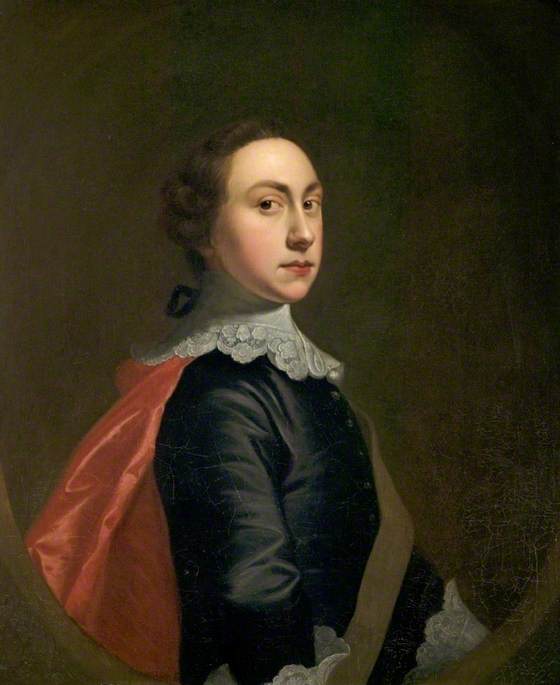
I have visited museums and art galleries on every continent and at hundreds of locations, including in this country – yet until fairly recently I had never visited any within my own city, Derby! Then, I discovered the Derby Museum and Art Gallery, and I began to take a greater interest in Joseph Wright of Derby and his paintings, thanks to the Joseph Wright Gallery located within that institution. I have now gone back there on many occasions.

I really must recommend the Derby Museum and Art Gallery. As well as the Joseph Wright Gallery, there are archaeology, military, natural history and other exhibitions. The staff are friendly, helpful and knowledgeable. There is an excellent café.
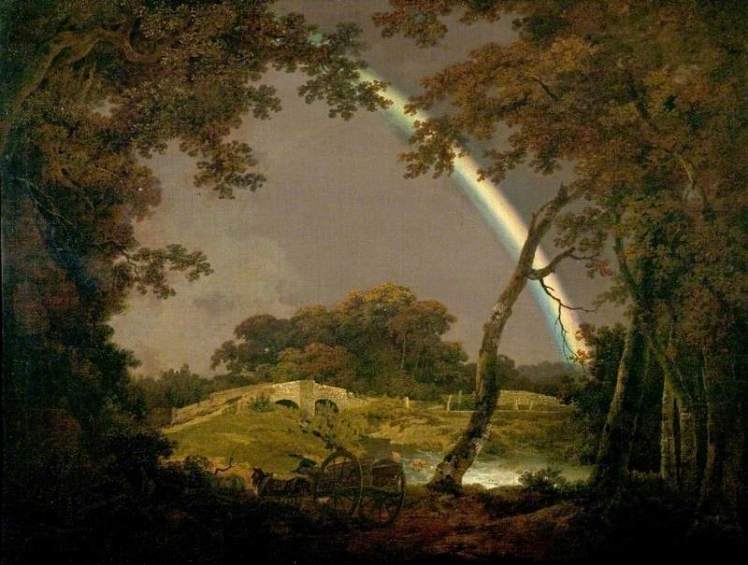
Joseph Wright was born in Irongate, Derby in 1734. The site of his birthplace is commemorated with a model of an orrery (a mechanical device, representing the solar system, that illustrates or predicts the relative positions and motions of the planets and moons) on the adjacent pavement. Wright studied in London and worked in Derby, Liverpool and Bath – but always returning to Derby. He spent a year overseas in Italy, which inspired some of his paintings.
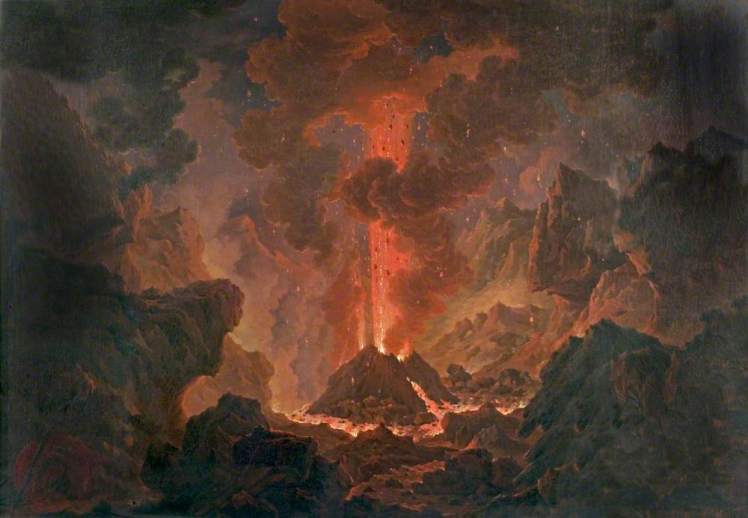
Wright died at 28 Queen Street, Derby in 1797 and was buried in the grounds of St Alkmund’s Church, Derby. Unfortunately, this church was demolished in 1968, as it was in the way of a new ring road. His remains were taken to Nottingham Road Cemetery, Derby. The tombstone was placed at the side of Derby Cathedral in 1997, and brought inside in 2002. During his lifetime, Wright knew many important local figures of the eighteenth century, including local industrialists (including Josiah Wedgwood, Richard Arkwright and Jedediah Strutt), scientists and philosophers (including Erasmus Darwin).

Within the Joseph Wright Gallery , my favourite paintings include Sir Richard Arkwright (1732-1792), Jedediah Strutt (1726-1797), Richard Arkwright Junior (1755-1843) with His Wife Mary, and Daughter Anne, Dovedale by Derbyshire Moonlight (which nicely demonstrates the chiaroscuro technique) and The Blacksmith’s Shop (a variant of The Hermitage’s Iron Forge).
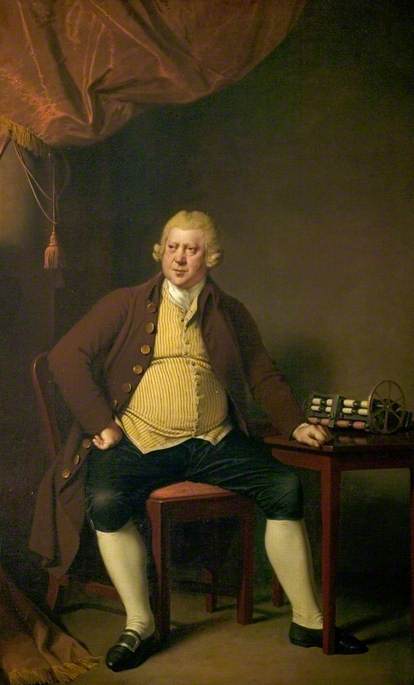
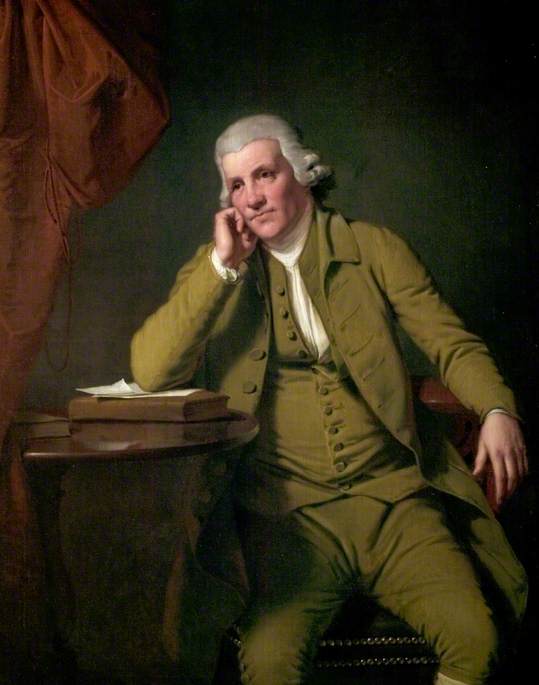
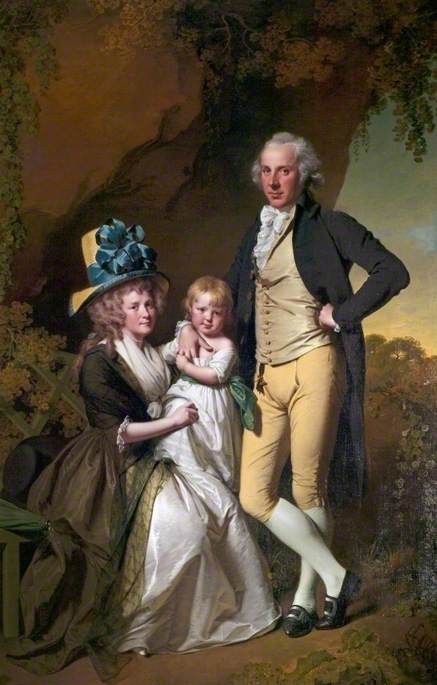

There is a replica of the Jedediah Strutt painting, hanging high up within the “Standing Order” pub on Irongate, Derby.
Dr Philip Dodgson, Derby, January 2024.
 PHILIP DODGSON OF DERBY ON JOSEPH WRIGHT OF DERBY